From 3 to 30 million meters in 30 years
Starting in 1996 with just a few machines and a bold decision, the company has grown into one of the most competitive hose manufacturing plants in the world today. The story of a partnership defined by trust, respect and continuous improvement of production processes.
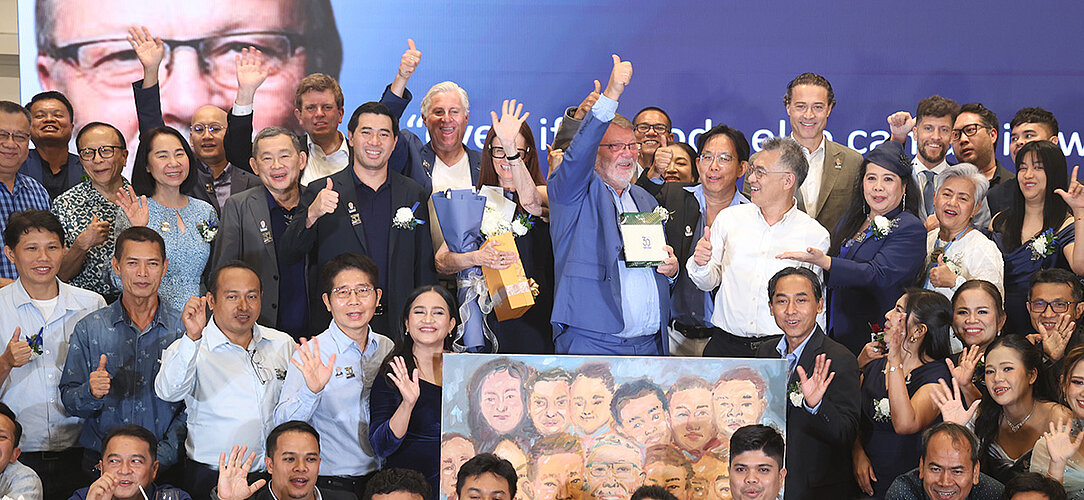
Michael Adelbauer is on his way from Semperit’s main site in Wimpassing to Odry in the Czech Republic, home to Europe’s largest hose factory. The T-shirt he is wearing bears the logo of the 30th anniversary of Semperflex Asia Corporation (SAC) – a small detail that highlights his connection to the site in Hat Yai in southern Thailand. Since the early days in the 1990s, he has shaped the development of SAC. Back then, when Adelbauer traveled to Thailand as a quality manager for a few weeks, there were no smartphones and no constant availability – but there was a clear vision: to establish a production site in Asia that would strengthen the global business in the long term. In 1996, this vision became a reality. Together with its Thai partner Sri Trang, Semperit founded Semperflex Asia Corporation.
Operations started with a capacity of about 3 million meters of hydraulic hose per year. Shortly afterwards, the Asian financial crisis hit the region with full force. While many infrastructure projects were halted, SAC focused on export markets, particularly in the USA. “To this day, the USA remains SAC’s largest market,” says Adelbauer. The hydraulic hoses are used in a wide variety of industries – from mechanical and process engineering to agricultural machinery and mining.
In the years that followed, the joint venture partners continuously expanded the site – capacity was increased, spiral technology was introduced, and a compounding operation was established. What began as a small operation with just a few machines evolved into a highly sophisticated production site. Capacity rose to 8.5 million meters at the turn of the millennium and now stands at around 30 million meters of hose per year. As part of Semperit’s global production network – which includes additional sites in the Czech Republic and China – SAC helps ensure that up to 350 kilometers of hydraulic hose are produced daily.
Our hoses can withstand one million load cycles.
Processes as quality assurance
However, the real competitive advantage does not lie in size. “What matters most is uncompromising process quality because it’s the best form of quality assurance – not control at the end, but perfection in the process itself,” Adelbauer emphasizes. Over the years, processes have been standardized, harmonized and technically perfected – at all sites. The result: consistent, reliable quality worldwide.
And the harmonization continues. The latest generation of spiral hose production – developed in Wimpassing and Odry – is currently being rolled out in Hat Yai. This technology enables higher pressure resistance, improved flexibility and better overall performance. “For customers, this means real added value,” says Raphael Farfeleder, who has served as Director of Operations for the Semperit Industrial Applications division since the beginning of the year and is Michael Adelbauer’s successor. “The hoses are easier to install and can withstand one million load cycles. The market requirement is 400,000 cycles.”
Our collaboration is based on trust and mutual respect.
Local strength and global integration
Farfeleder has long been familiar with the site and the hose business. Having been with Semperit for about 13 years and now visiting the site in Thailand four times a year, he has worked closely with Adelbauer. He considers his role to be clearly defined: building on what has proven successful while also providing new impetus: “We’re building on a strong foundation – both technologically and in terms of partnerships.” The 50:50 joint venture with Sri Trang follows a clear logic: both partners focus on their respective strengths. Sri Trang manages approximately 400 employees on site – many of whom have been part of the company for years or even decades – and takes care of stakeholder management, while Semperit contributes the technology and is responsible for product development and sales. “This combination of global integration and local strength is a typical win-win situation,” Farfeleder sums it up.
The joint venture is not only built on strategy and structure, but especially on trust, as Suchart Saepong, plant manager at SAC in Hat Yai, emphasizes: “Our collaboration is based on trust, open communication and mutual respect. One of the most important lessons we’ve learned over the past 30 years is that understanding different cultures makes us stronger. We’ve learned that success depends not only on technology, but on people who are willing to learn from each other. These values have helped us tackle challenges as a team, and they will continue to guide us in the future.”
“People feel like they’re part of a bigger picture,” says Suchart Saepong. “They know their contribution matters. We believe in ‘one team – one goal.’” For Farfeleder, this is his predecessor’s legacy: “Michael showed us how important trust and fairness are and that it’s essential to understand details in depth in order to question things and move forward.” Three decades after producing its first few meters of hose, SAC stands as a prime example of what constitutes long-term success and resilience: a clear vision, a strong partnership – and the ability to continuously evolve.


